
Modern tools like Lovable and Cursor can produce high-fidelity, interactive prototypes in minutes. They’re genuinely exciting, and they’ve lowered the barrier to experimentation in ways that were unimaginable just a few years ago. For many product teams, this means more frequent and lower-cost experiments at greater scale.
A participant of one of my product management classes recently asked “can you also use Lovable to create something silly, such as a webshop for inflatable crocodiles?” As we found out on the spot after typing 2-3 sentences in Lovable: sure you can! (see below)

This opens up a playground of possibilities. But it also opens up a trap.
When something looks polished, the temptation is to launch it. Stakeholders who might otherwise have pushed back on whether a problem is real and worth solving instead find themselves saying “looks awesome, let’s build it.” The conversation shifts from problem to solution before you’ve earned the right to be there. Discovery becomes a checkbox, and before long you’re back in a feature factory, obsessing over output instead of outcomes.
This is where Giff Constable’s Truth Curve becomes essential, and specifically its x-axis.
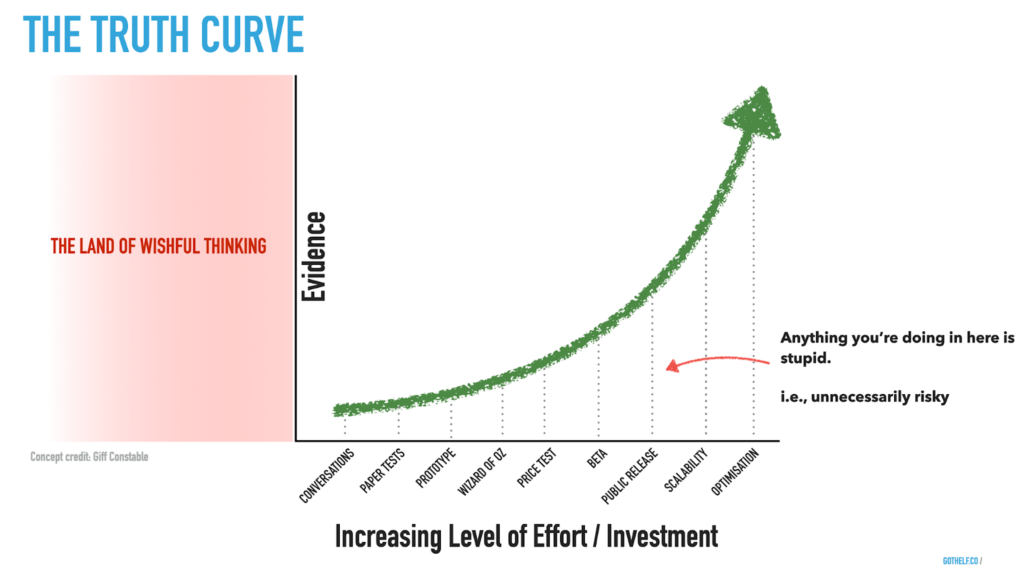
The x-axis represents your level of certainty: how much you actually know about whether your assumptions hold. Have you established that people have the problem you think they have? Do you understand it well enough to know what a good solution looks like? The x-axis is a honest reckoning with what you know and what you don’t, and it should be the starting point of every discovery conversation.
The y-axis, cost of learning, then follows naturally. Early in discovery, when certainty is low, the cost of learning should be low too. Think interviews, sketches, or simple landing pages. Not because these methods are old-fashioned, but because investing in a high-fidelity prototype before you’ve established problem fit is a waste at best and misleading at worst. As your certainty grows through evidence, it makes sense to move up the curve toward higher-fidelity prototypes and live experiments.
The danger of rapid prototyping tools is that they decouple fidelity from certainty. You can have a beautiful, interactive prototype after a few prompts and still know almost nothing about whether you’re solving a real problem for real people. That’s the trap.
Paper prototyping, for all its low-tech simplicity, has always been good at keeping that gap honest. It’s fast, disposable, and deliberately unpolished. It makes it easy to focus on the problem rather than getting distracted by the solution. Paper invites critique because it doesn’t look finished, and that’s precisely the point. But the method matters less than the mindset. Whether you’re sketching on a napkin or building in Lovable, the questions that should drive every discovery effort remain the same: What are we trying to learn? What assumptions are we testing? Where are we on the certainty spectrum, and are we using methods that match that?
The basics of product management don’t bend for better tools. Rapid prototyping is a powerful amplifier, but it amplifies whatever you feed it. Feed it untested assumptions and you’ll get beautiful answers to the wrong questions, faster than ever before.
Tools don’t replace the messy but essential work of discovery. They augment it. The art of product management lies not in what you build or how quickly you can make it look real, but in how honestly you track what you know, what you’ve tested, and what you’re still guessing at.